


Why Strong Branding Builds Trust Faster

Trust is one of the most valuable things a business can earn, but it does not begin when a customer speaks to you. It starts much earlier.
It begins the first time someone sees your logo, visits your website, scrolls through your social media, receives your proposal, compares your packaging, or reads your message. Before people understand every detail of what you offer, they are already deciding whether your business feels credible, professional, and worth their attention.
That is why strong branding matters.
A strong brand helps people make sense of your business faster. It reduces doubt, increases perceived value, and creates a more confident first impression. It does not replace a good product or service, but it helps people believe in that product or service sooner.
Strong branding builds trust faster because it gives people visual, verbal, and emotional signals that say:
- This business is serious.
- This business is clear.
- This business knows what it is doing.
- This business feels consistent.
- This business is worth considering.
Below are five ways strong branding helps businesses earn trust before the first conversation even begins.
1. First Impressions Shape Perception
People form opinions quickly. Before they read your full offer, compare your pricing, or understand your process, they are already reacting to how your brand looks and feels.
This does not mean customers are superficial. It means humans use visual signals to make fast judgments. A brand that looks polished, intentional, and aligned creates a different feeling than one that looks unfinished, inconsistent, or generic.
What people notice first
When someone discovers a brand, they often notice things like:
- the quality of the logo
- the website layout
- the colors and typography
- the photography or imagery
- the way information is organized
- the tone of voice
- the consistency between platforms
- the overall feeling of professionalism
These elements quietly communicate whether the business feels trustworthy or not.
The perception gap
Two businesses can offer similar services, but the one with stronger branding often feels more credible before the customer even compares details.
| Weak Brand Impression | Weak Brand Impression |
|---|---|
| Weak Brand Impression | Strong Brand Impression |
| Looks improvised | Looks intentional |
| Feels unclear | Feels easy to understand |
| Creates hesitation | Creates confidence |
| Seems early or unprepared | Seems established |
| Feels generic | Feels memorable |
| Makes people question value | Makes value easier to believe |
A strong brand does not just make a business “look better.” It changes the way people interpret the business.
Why this builds trust faster
When your first impression feels professional, people start with more confidence. They are more likely to continue reading, explore your work, ask questions, and consider taking the next step.
A weak first impression makes the customer work harder. They need more proof, more explanation, and more reassurance. A strong first impression reduces that friction.
Key takeaway
People decide how seriously to take your business before they fully understand it. Strong branding helps that decision start in your favor.

2. Consistency Makes a Brand Feel Reliable
Trust grows when people experience the same brand clearly across different touchpoints.
If your website feels premium, but your social media feels random, your proposal looks outdated, and your presentation has a completely different visual style, people may not consciously analyze it, but they feel the inconsistency.
That inconsistency creates doubt.
Why consistency matters
Consistency tells people that your business is organized. It suggests that there is a system behind what you do. It makes your brand easier to recognize, easier to remember, and easier to trust.
Strong branding creates rules and direction for how your business should appear across:
- website
- social media
- proposals
- presentations
- packaging
- ads
- email signatures
- business cards
- brochures
- internal documents
- investor decks
- product visuals
When all of these touchpoints feel connected, your brand feels more mature.
Brand consistency in practice
| Brand Element | What It Controls | Why It Builds Trust |
|---|---|---|
| Logo system | How the brand is identified | Makes recognition easier |
| Color palette | Emotional & visual consistency | Creates familiarity |
| Typography | Tone and readability | Makes communication controlled |
| Image style | Visual mood and quality | Supports perception |
| Tone of voice | How the brand speaks | Makes the brand feel coherent |
| Layout system | Structure and visual rhythm | Improves clarity |
| Guidelines | Rules for correct usage | Prevents visual chaos |
The problem with inconsistent branding
Inconsistent branding can make a business look smaller, less prepared, or less reliable than it actually is.
Common issues include:
- different logo versions used randomly
- inconsistent colors across platforms
- mismatched fonts
- social media that does not match the website
- low-quality presentations
- unclear design hierarchy
- proposals that feel disconnected from the brand
- visuals that change style every week
Even if the product or service is good, inconsistency weakens perception.
How strong branding fixes this
A strong brand gives the business a visual and verbal system. It helps everyone involved make better decisions, faster.
Instead of asking, “How should this look?” every time, the brand already provides direction. That saves time and creates a more reliable customer experience.
Key takeaway
Consistency makes people feel like your business is stable, professional, and prepared. Trust grows when every touchpoint feels like part of the same brand.


3. Clarity Reduces Doubt
People do not trust what they cannot understand.
If your brand is confusing, if your message is vague, or if your visuals do not match the value you offer, potential customers may hesitate. They might not know exactly why, but something feels unclear. Strong branding helps reduce that doubt.
What clarity does for a brand
Clear branding helps people understand:
- what you offer
- who it is for
- what problem you solve
- why your business matters
- what makes you different
- what level of quality they can expect
- what action they should take next
This does not mean your brand needs to explain everything at once. It means every touchpoint should make the decision easier, not harder.
Clarity vs confusion
| Confusing Brand | Clear Brand |
|---|---|
| Weak Brand Impression | Strong Brand Impression |
| Looks improvised | Looks intentional |
| Feels unclear | Feels easy to understand |
| Creates hesitation | Creates confidence |
| Seems early or unprepared | Seems established |
| Feels generic | Feels memorable |
| Makes people question value | Makes value easier to believe |
Where clarity shows up
Brand clarity is not only in the tagline. It appears everywhere:
Website
A clear website helps visitors understand what you do quickly and move through the page without confusion.
Social Media
Clear content makes the brand easier to follow, remember, and engage with.
Sales Materials
Clear proposals and decks help potential clients understand the value of the offer faster.
Packaging
Clear packaging helps customers understand the product, its category, its benefits, and why it is worth choosing.
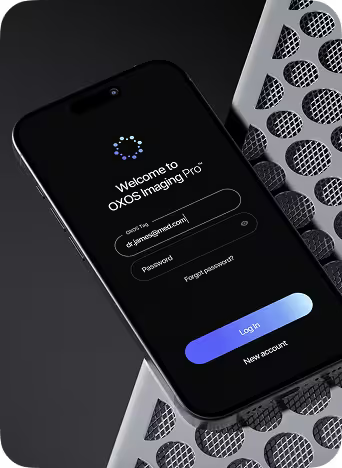
UX/UI
Clear interfaces reduce frustration and make digital products feel more trustworthy.
Why clarity creates trust
Confusion creates hesitation. Hesitation slows down decisions. The more a customer has to guess, the less confident they feel.
A clear brand removes mental friction.
It helps the customer think:
- “I understand what they do.”
- “This looks professional.”
- “This feels relevant to me.”
- “I can see how this helps.”
- “This seems like a serious business.”
That is how clarity builds trust.
Key takeaway
A clear brand makes people feel safer choosing you because they understand your value faster.

4. Professional Design Increases Perceived Value
People often connect visual quality with business quality.
If a brand looks premium, refined, and carefully built, people are more likely to assume the product or service has value too. If a brand looks careless, generic, or outdated, people may question the quality before they ever experience the offer.
This is not just about decoration. It is about perception.
Perceived value matters
Perceived value is the value people believe something has before they fully experience it.
Branding influences perceived value through:
- design quality
- presentation
- consistency
- language
- visual confidence
- attention to detail
- professionalism
- emotional tone
A strong brand helps your business look more valuable because it presents your offer with more intention.
Examples of perceived value
| Scenario | Weak Branding Effect | Strong Branding Effect |
|---|---|---|
| A startup seeking clients | May feel unproven | Feels more established |
| A product on a shelf | May blend in | Feels more desirable |
| A service proposal | May feel low-value | Feels more professional |
| A website visit | May cause doubt | Builds confidence |
| A social media profile | May look inactive | Feels active and credible |
Why people pay more attention to polished brands
A polished brand signals care. It tells people that the business pays attention to details. And when people see care in the presentation, they are more likely to believe there is care in the product, service, or experience.
That does not mean every brand needs to look luxurious. It means the brand needs to look aligned with the value it wants to communicate.
A financial brand should feel trustworthy.
A wellness brand should feel calm and credible.
A restaurant brand should feel appetizing and memorable.
A technology brand should feel clear and capable.
A premium service should feel refined and intentional.
Strong branding makes the value easier to believe.
Key takeaway
People use design quality as a signal of business quality. Strong branding helps your offer feel more valuable before the sale.



5. Strong Branding Creates Confidence Before the Sale
The sales process does not begin when someone contacts you. It begins when they first experience your brand.
By the time a potential customer fills out a form, sends a message, books a call, or adds something to cart, they have already built a level of confidence or doubt.
Branding influences that decision long before direct contact.
The invisible trust journey
Before a customer reaches out, they may have already seen:
- your homepage
- your services page
- your portfolio
- your testimonials
- your social media
- your pricing or packages
- your case studies
- your product photos
- your ads
- your email
- your proposal
- your packaging
Each one either builds confidence or weakens it.
What strong branding does before the sale
Strong branding helps your business:
- look more established
- explain value faster
- feel more professional
- reduce hesitation
- increase recognition
- make a better first impression
- support higher pricing
- improve the customer journey
- create emotional confidence
- help people feel safer taking action
Branding and conversion
Branding is not the same as conversion strategy, but it strongly supports conversion.
A visitor is more likely to convert when they feel:
- the business is real
- the offer is clear
- the design feels professional
- the message is relevant
- the experience feels consistent
- the next step feels safe
Strong branding supports all of these.
Before and after example
| Before Strong Branding | After Strong Branding |
|---|---|
| “I’m not sure if this business is legit.” | “This feels professional.” |
| “I don’t understand what they offer.” | “I get what they do.” |
| “This looks a bit random.” | “This feels organized.” |
| “Maybe I should compare more options.” | “This seems like a strong choice.” |
| “I’m not ready to reach out.” | “I feel comfortable asking.” |
Key takeaway
Strong branding helps people feel confident before they ever speak with you. That confidence makes every next step easier.
Practical Signs Your Branding May Be Weakening Trust
Not every business needs a full rebrand immediately. But there are signs that your current branding may be creating doubt instead of confidence.
You may need stronger branding if:
- your website looks outdated compared to your competitors
- your social media does not match your website
- your logo feels generic or hard to use
- your business materials look inconsistent
- customers do not quickly understand what you offer
- your brand feels less premium than your actual service
- your presentations or proposals feel unpolished
- your product packaging does not stand out
- your team uses different colors, fonts, or styles randomly
- your brand no longer reflects where the business is going
A quick self-check
Ask yourself:
| Question | Why It Matters |
|---|---|
| Does my brand look as professional as my service? | Perception should match quality |
| Can people understand what I offer quickly? | Clarity reduces hesitation |
| Do all touchpoints feel connected? | Consistency builds trust |
| I’d feel confident sending my website to a high-value client? | Confidence affects selling |
| Does my brand help me stand out? | Differentiation supports growth |
What Strong Branding Should Include
A strong brand is not just a logo. It is a system.
Depending on the business, strong branding may include:
Core Identity
- logo system
- color palette
- typography
- brand marks
- icon style
- visual language
Strategic Foundation
- brand positioning
- audience definition
- competitive direction
- brand personality
- values
- mission and vision
Communication
- tone of voice
- key messaging
- tagline or slogan
- content style
- brand story
Real-World Applications
- website
- social media
- packaging
- presentations
- stationery
- ads
- brochures
- proposals
- signage
Brand Guidelines
- logo usage
- spacing rules
- color rules
- typography rules
- imagery style
- do’s and don’ts
- application examples
A brand becomes stronger when these parts work together.
Conclusion
Strong branding builds trust faster because it reduces uncertainty.
It helps people understand your business, recognize your value, and feel more confident choosing you. It shapes the first impression, creates consistency, improves clarity, increases perceived value, and supports the decision-making process before the sale even begins.
A strong brand does not need to be loud. It needs to be clear, consistent, and intentionally built. Because trust does not start after the customer contacts you.
It starts the moment they see you.

Next Stories You May Like